The Token-to-Equity Playbook
 Johnny ReinschOctober 3, 202610 min read
Some tokens should never have been tokens. Centrifuge just became the first project to put that question to its community and get a clear answer: 98.5% of CFG voters chose to convert the token into tokenized equity. I've been advising on the transaction through Tesseract, and this week Charlie let me take the whole episode to walk through it from the inside, phase by phase. My goal is a template. If you run a token project and you've been quietly wondering whether you should do this too, you should come away knowing whether you can.
Market KPIs (brought to you by RWA.xyz)
📈 RWA market cap was up 0.3% WoW to $38.7 billion
🏆 Biggest RWA winner: Tether Gold (XAUT) added $310M
🏆 Biggest network winner: Ethereum added $140M
📈 Stablecoin market cap was down 0.2% WoW to $294.9 billion
🏆 Biggest stablecoin winner: USDT added $313M
🏆 Biggest network winner: TRON added $225M
📈 Onchain risk free rates:
SOFR: 3.90% (steady WoW at last week's elevated level)
Aave / DeFi: just above 4% (up 11 bps WoW, about a point more yield than a month ago)
One more from Charlie: Hyperliquid will soon start using the yield on the roughly $7 billion of USDC on HyperEVM to buy back HYPE. That's about 3.5% of the balance, every year, going to buybacks.
Going First Takes Guts
Before the mechanics, a thank-you. Going first is hard and scary. You catch arrows no matter what, even when you're doing the right thing. A truly decentralized project has thousands of people with an opinion, and you have to listen to all of them while holding on to what's actually best for everyone. Bhaji, Anil, Martin, Jeroen, Eli, and the rest of the Centrifuge team have shown real mettle through this whole process. It's been inspiring to work alongside them, and anyone thinking about doing this should know up front that it takes that kind of conviction.
The Threshold Question: Token or Equity?
Every project considering this has to start with an honest look inward. Why do we have a token? Would a share class serve us better?
The pattern I keep seeing is that some token projects should absolutely stay tokens. The network runs on the token, and the token is the product. But there's another cohort for whom the token no longer makes sense, even if it did at launch. Their businesses evolved. Their customers are now institutions, and institutions still have open questions about whether they can hold a token at all. A partner who would happily take equity in your company gets stuck when the thing on offer is a governance token.
That's the tell. When you start losing deals, or the deals you win get scoped smaller than they should be because the token is in play, conversion starts to make a lot of sense.
Look at Securitize. Carlos and the team have been in this game long enough that "when do we launch a network and a network token?" must have come up over and over. They never did. They went public instead, with a share class that also trades in tokenized form, and I don't think that was an accident when BlackRock is your flagship commercial relationship.
Not Quite M&A, Not Quite Crypto
I started my career as an M&A lawyer at Kirkland & Ellis, spent a short stint at Wilson Sonsini, then left to help my mentor, Larry Chu, build the tech M&A practice at Goodwin Procter. Larry is a legend in that world, and the most valuable thing he taught me was to think from first principles. By year five I was helping sell DeepMind to Google, representing Founders Fund and Horizons, back when almost nobody knew what AI was.
A lot of this transaction pattern-matches to an M&A deal. You have a globally distributed holder base across many tax and legal jurisdictions, complex governance, and a real question of how you get approvals. But corporate law doesn't map neatly onto crypto. You have a community, governance forums, onchain voting, and a board that sits inside a foundation in Cayman or BVI. This deal is its own animal, a bridge between the two worlds, and it's unlike anything I've done on either side.
Phase One: Learn the Rules of the Game
The simple headline, "token to equity," hides a lot of complexity. The first phase is building the rulebook: everything that has to be true for the transaction to work. How does governance actually function? What does the holder distribution look like? Who actually votes? Which contracts that the foundation and its subsidiaries have signed (market makers, exchange listings, and so on) does a deal like this touch? You want all of that understood before you post anything, because you never want to propose something that's legally or structurally impossible.
I did this phase with AI, for the first time in my career. As an M&A associate with a team, it would have taken a month. I got to about 95% saturation in four days. Today I can open a terminal in the project, ask any question that comes up on a call, and get a precise answer with a citation I can check. Charlie compared it to Harvey and the other legal AI companies, and he's right that their real moat is protecting client data at scale. I'm not practicing law here, though. My role is project manager, coordinating the law firms and service providers alongside the team. Between you and me, that's what M&A lawyers mostly are anyway.
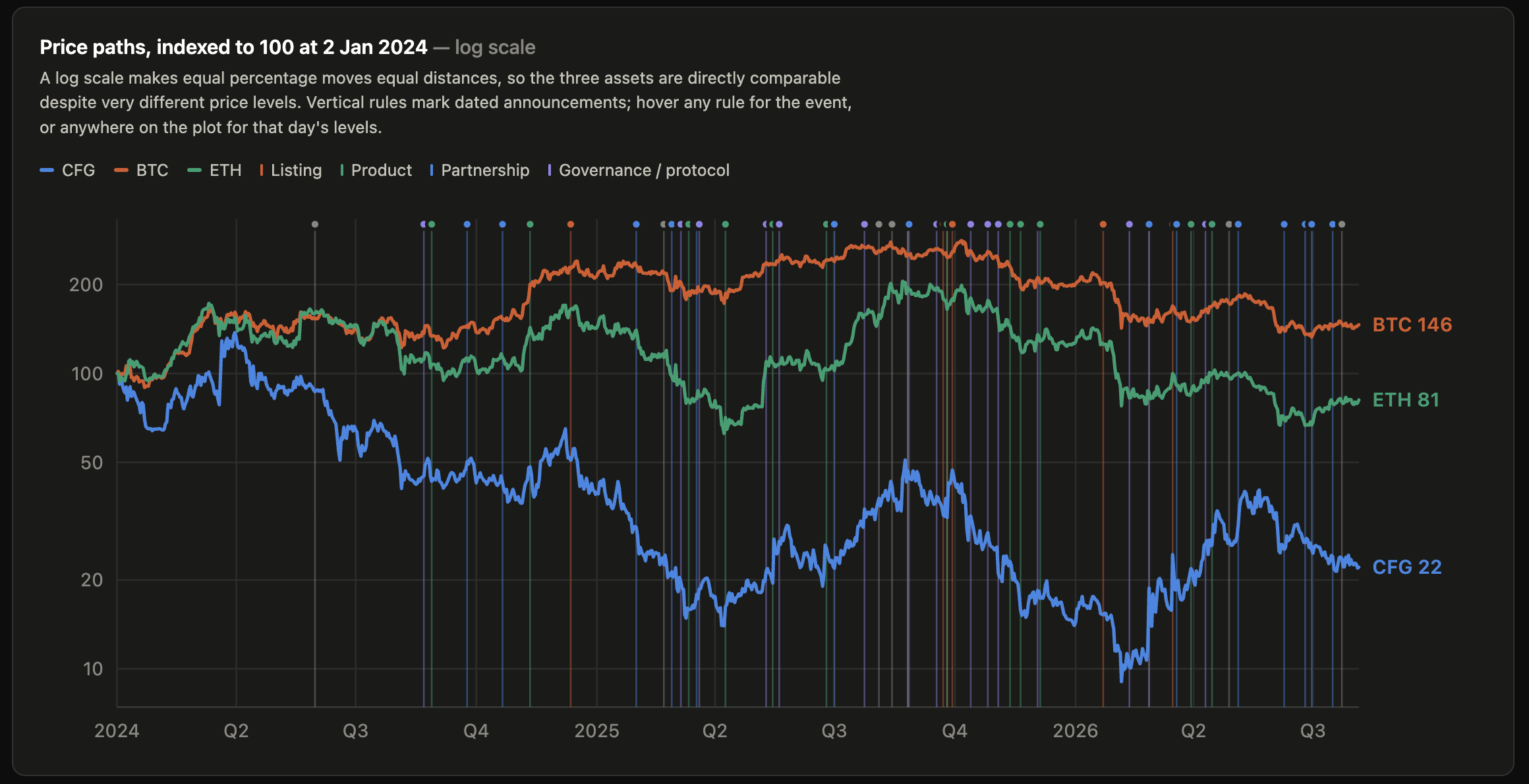
Part of this phase is building conviction that a request for comment is even worth posting. I pulled four years of CoinMarketCap price data, every post on Centrifuge's blog, all of the news about the project, and its core metrics from Dune, then mapped how CFG's price reacted to news and to changes in revenue and TVL. The answer was striking. CFG traded almost like pure ETH beta, with a little leverage on top. There was very little alpha in holding the token. If it had been the other way around, it would have been much harder to argue that the token was holding the business back. Instead, the data said the token wasn't even tracking the business. As Charlie put it, holding CFG was basically holding levered ETH, and that's no good for the team holding it, or for the institutions you'd want to bring in.
Galaxy also built a model of likely trading ranges based on available exchange volume, so we understood what a max-pain market reaction might look like just from posting the RFC. A private company in an M&A process never has a public price talking to it every day. A token project does, and even the most hardened management teams feel it. Having those scenarios in hand gave the team, and me, the confidence to proceed, plus pre-agreed points to decide whether to keep going or pivot.
Phase Two: The Request for Comment
Once the RFC is posted, you're in a new phase, and it's the most frustrating one. A decentralized token sits in a reasonably well-understood place under securities law. Once a security enters the picture at the end, the analysis changes. We wanted to discuss the proposal freely, but we couldn't risk anything that might read as an offer to sell a security. Every response had to be careful.
So I built a system for it. It scraped the governance forum, pulled X for sentiment, and ran a news feed so discussions happening anywhere else got caught too. Starting on day one, it dropped a digest on the management team: how many questions came in, how they clustered by topic, which ones we should answer and could answer. A separate service drafted suggested FAQ answers for counsel to review. Charlie compared it to Yext, which consumer brands use to track sentiment across reviews and social. Same idea, built for a single transaction.
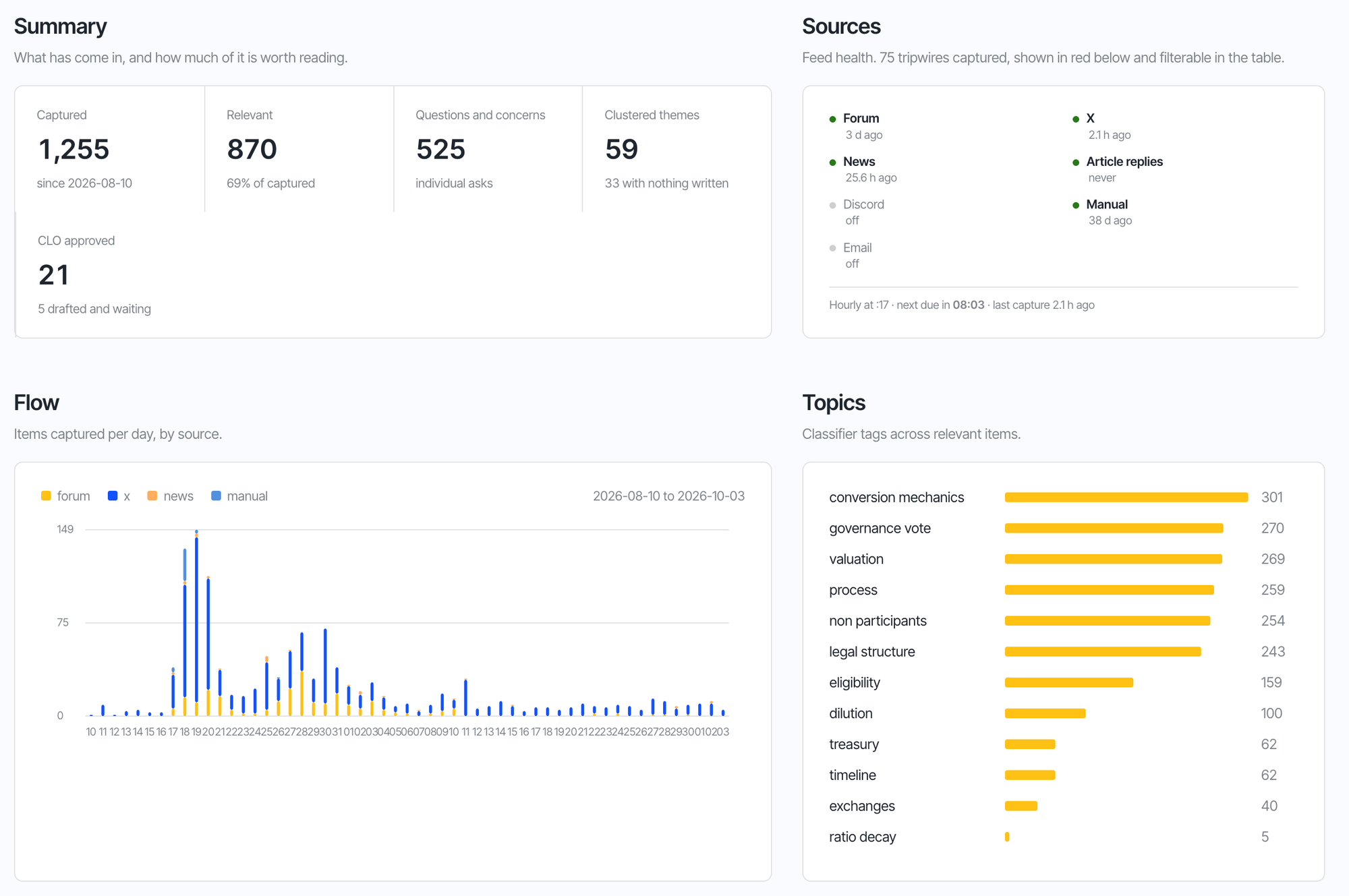
We didn't answer in real time, because every answer fractals into its own set of follow-up questions. Instead we let questions pile up and released a new version of the FAQ roughly weekly. The data told us when to release. Question volume would naturally dip as people reached the end of a thread of discussion. That was the signal we had a good batch. We'd release answers, the line would jump back up with new questions, and we'd do it again. The output is the CP172 FAQ on Centrifuge's blog.
Compare that to my old life. A tender offer or shareholder vote meant mailing out a 300-page document with a checkbox at the end, then waiting at least 60 days. Here, the discussion ran in real time and wrapped in about two weeks.
Phase Three: The Vote
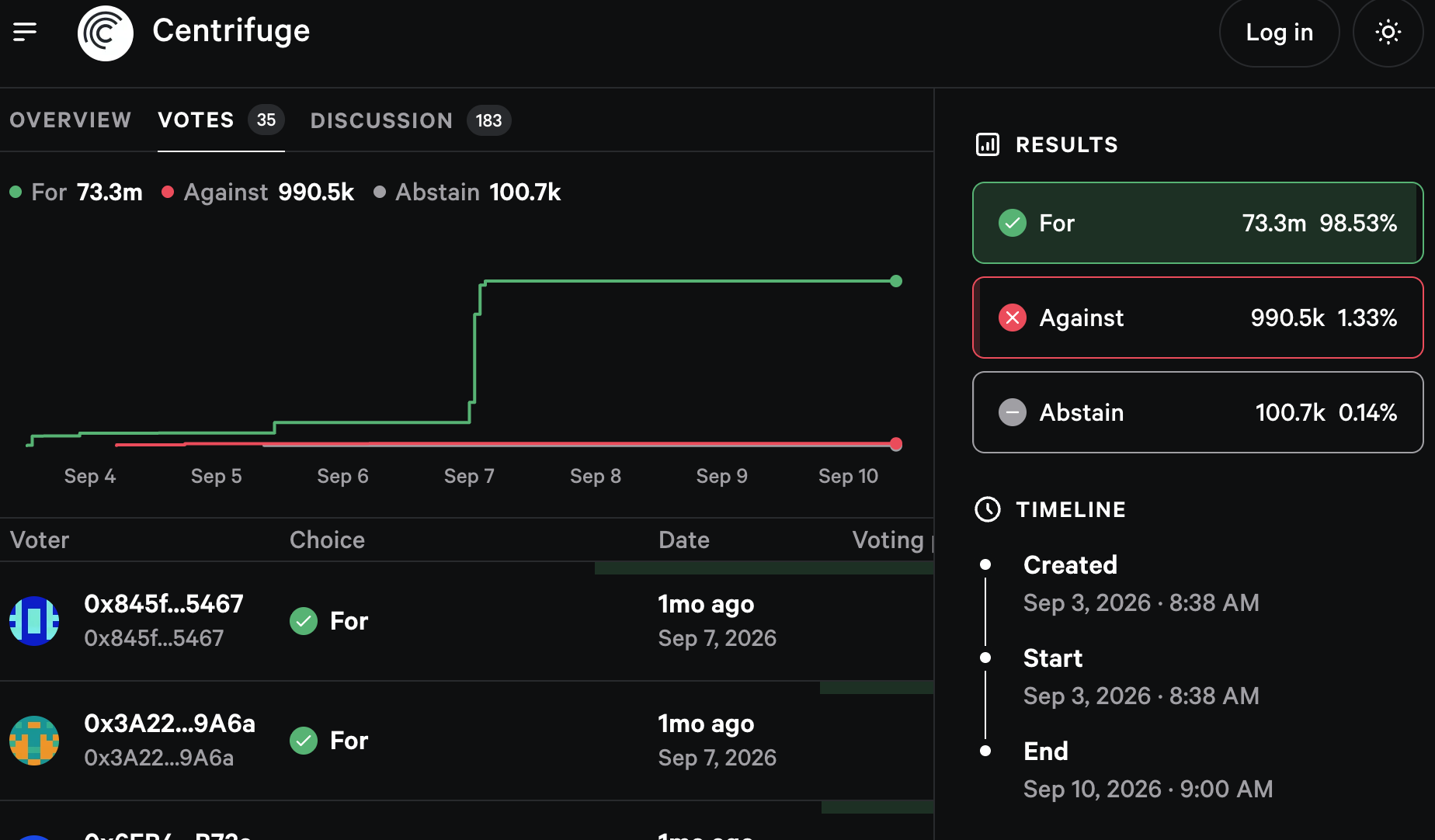
When discussion wound down, we opened a one-week vote on Snapshot. Beforehand I went through every governance vote Centrifuge had ever held and built a distribution of ordinary-course versus contentious votes: typical turnout, the record turnout, and what the contentious ones looked like. You never know how a vote will go, but you still try to know, and I used it to manage expectations with the team and the community.
I was more bearish than I let on. My estimation based on the data was about 70% in favor, which would still have been a great outcome. It came back 98.5%. It was the highest turnout and the most discussion in CFG's history: about 74 million CFG voted, roughly five and a half times the previous record. An absolute landslide.
Phase Four: Conversion
The vote doesn't do the deal. It means the community has agreed. The phase we're in now works backward from one experience: someone with CFG in their wallet leaves with a tokenized share.
Because it's a share class, holders will need to go through KYC, eligibility checks and investor accreditation, as applicable. CoinList is handling that for us, and they deserve a big shout-out, because we are almost certainly one of their more complex relationships. (Hosting Ondo is a lot more straightforward than hosting us.) Eligible holders will then go into the Centrifuge app and exchange CFG for shares at a one-to-one ratio. The share class is natively issued onchain and can sit in your wallet. To set expectations: it will be heavily restricted, and you won't be able to do much with it. I'm not going to give a timeline for opening up the conversion UI because then it'd be wrong and people would rightly be annoyed.
All of that complexity boils down, for the holder, to connecting a wallet, confirming an amount, and leaving with shares. Behind it sit legal, tax, regulatory, and smart contract workstreams running in parallel. Doing this as a traditional paper-based equity conversion would honestly have been easier. Making it a true tokenized equity, one that works properly as a matter of law, is extra work. Centrifuge chose to do it anyway, because they believe in the tokenization thesis to their core. It's been a maniacal, detail-oriented exercise, honestly more complex than many of the cross-border deals I did as a lawyer, and the culminating event will be abundantly mundane. That's the point.
Who Keeps the Register?
Charlie asked what happens after conversion. Centrifuge has a transfer agent, which plays the role Computershare plays for a traditional company: it keeps the record of who owns what. Holders will see their balance in the Centrifuge app, and the way Centrifuge built this means it can do the same for other projects considering a conversion, or for companies that simply want a tokenized share class.
Computershare does a great job. I've become intimately familiar with their service as I've handled stock transactions for my parents. I think the tokenized version and the paper version will live side by side for a long time. But once tokenized share classes have real features (Centrifuge's vault infrastructure is built for exactly that), I don't see why you'd hold the old-school version if you can have the tokenized one.
The Precedents
Charlie did some digging, and this really is close to uncharted territory. Bitfinex did something like it in 2016, offering equity to compensate holders of its BFX recovery token after the hack, though that was a hack recovery rather than a conversion. ICN offered shares alongside its token. Modum offered a Swiss participation certificate, non-voting equity, in 2020. Most recently, Across launched a conversion portal where ACX can be exchanged one-to-one for equity securities.
The precedent I learned the most from was Maker's move to Sky. Rune is very good at governance, and because all of it was public, I could study everything they went through. Across was useful as the most recent example. The big difference with Centrifuge is that the share class itself is natively onchain.
Who's Next
If you're considering one of these transactions, bring in someone who can focus on it full time. I'm not marketing my services here (frankly, I don't have time for more of these). But there's no role inside a company that should pay the distraction tax of this deal on top of their day job, least of all the CEO or the head of BD. Reach out, and I'll point you to the right people and share templates for the tools I described. And if you want a tokenized share class, talk to the Centrifuge team. They have the template now.
Another thing to note is there's a big pipeline of projects that should convert to equity and would likely be successful in doing so. Using the same analysis I ran on CFG, plus what this vote taught me about how predictable these outcomes are, I've found roughly 25 token projects (on top of the inbound discussions I've already had) that I think should make this move, and where the math says it would likely pass.
I'm not going to share the list because that'd probably cause headaches for the token projects.
What we'll do instead is send you a report about a project you're curious about. The report will cover whether the project should graduate and whether a tokenholder vote would be likely to succeed.
Use this link to get your report.
Disclosure: I advised Centrifuge on this transaction through my advisory, Tesseract. Nothing in here is legal or financial advice nor an offer of securities.
Watch or listen to the full episode on Spotify.

![[███░░░░]: Crypto mom lays the path for DeFi](/_next/image?url=https%3A%2F%2Fstorage.ghost.io%2Fc%2Fdf%2F2c%2Fdf2c7059-8617-4d25-9617-996aea279325%2Fcontent%2Fimages%2F2026%2F09%2FProgress-Bar-5.jpg&w=3840&q=75)