The SEC Opened the Door to Tokenized Stocks on AMMs. But how wide?
 William Fabian SandersOctober 2, 20267 min read
After many months of anticipation, the SEC finally released its Innovation Exemption: an order that allows AMMs to list tokenized securities while being exempt from the onerous rules governing traditional trading venues such as national securities exchanges and alternative trading systems. The exemption of course is conditional and effectively requires AMMs that list Tokenized Securities to follow a plethora of rules.
Among those rules, the order caps tokenized-securities AMMs at 75 Tier 1 symbols and 250 Tier 2 symbols per project, with per-symbol volume caps of 0.25% and 2.5% of prior-month average daily share volume. Once you translate those percentages into dollars, the picture is specific: across the top 75 Tier 1 names, the volume cap works out to roughly $700 million a day. That is about a third of Uniswap's daily volume and more than Aerodrome or Raydium trade today. Enough to matter, but the caps preclude any near-term merger of DeFi and TradFi liquidity. The SEC is letting issuers meaningfully participate in DeFi. It is not opening the flood gates.
In this note we unpack the regulatory jargon and illustrate what these caps look like in practice. First, we discuss who is capped and what the symbol and volume caps are, then what they actually allow, using market data. Finally, an implementation problem baked into the order: the volume cap is defined against data that an AMM cannot know in real time.
The Caps Apply Per Project, Not Per Pool
Before discussing the numbers, we will tackle the scope. Are the caps computed per pool or across all exempted pools? They apply per project.
The order establishes "Tokenized Securities Venues" (TSVs): entities that deploy and maintain AMMs trading tokenized securities. These AMMs can be largely decentralized, but a TSV has the key responsibility of determining who has access to the AMM in order to comply with sanctions laws and to run anti-fraud and anti-manipulation programs. To be clear, a project is not a TSV simply because it wrote code or deployed a factory contract. A TSV controls access.
The caps apply per TSV. If a TSV controls multiple AMMs across several chains, the caps apply to the aggregate volume and listings on all of them. Furthermore, the caps also apply to each group of "affiliated" TSVs. If two TSVs are controlled by a common entity, they are affiliated and their caps aggregate. This prevents a project from bypassing the caps by spinning up multiple entities.
So for example, if Uniswap and Pancakeswap each wanted to deploy and manage access for tokenized-securities pools, each individual organization would have its own caps: Uniswap's caps would apply to the aggregate of all Uniswap pools on all chains.
75 Symbols for the Majors, 250 for Everything Else
The listing language:
Tier 1 Tokenized NMS Stock traded on a TSV… cannot exceed 75 symbols traded.... Tier 2 Tokenized NMS Stock traded on a TSV… cannot exceed 250 symbols traded....
NMS Stocks are, practically speaking, all securities listed on national securities exchanges that are not options. That includes most publicly traded equities: the S&P 500, Russell 1000, and large-cap ETPs. Google, Apple, and (counterintuitively) the Vanguard S&P 500 ETF are all NMS Stocks.
The National Market System (NMS) is an umbrella term for the rules, institutions, and technologies that unify US securities trading venues into a single interconnected market. A key piece is transaction reporting plans, through which the SEC requires financial institutions to report trading data on certain securities. Transaction reporting plans aggregate data from national securities exchanges, alternative trading systems, and OTC deals facilitated by broker-dealers, and make it available to the SEC and market participants. An NMS Stock is a non-option security subject to a transaction reporting plan.
NMS Stocks are classified into two groups. Tier 1 is the majors: S&P 500 stocks, Russell 1000 stocks, and large ETPs. They have high market cap, high liquidity and include Google, Apple, the Vanguard S&P 500 ETF. All NMS Stocks that are not Tier 1 are Tier 2: mid, small, and micro caps, with GameStop as probably the most famous example.
The Innovation Exemption only permits a TSV to list 75 Tier 1 NMS Stocks and 250 Tier 2 NMS Stocks. Thus a TSV cannot list even half the S&P 500, though it can list a tokenized form of the Vanguard S&P 500 ETF. The symbol caps are already a real restriction.
0.25% of Daily Volume Is About a Third of Uniswap
The volume language:
Tier 1 Tokenized NMS Stock traded on a TSV… cannot exceed… 0.25 percent of the average daily share volume …. Tier 2 Tokenized NMS Stock traded on a TSV… cannot exceed … 2.5 percent of the average daily share volume...
Because NMS Stocks are subject to transaction reporting plans, official daily volume data exists, and the cap is computed as a percentage of that daily volume. The reported volume includes all trades on national securities exchanges and alternative trading systems, plus all OTC deals facilitated by broker-dealers. For Tier 1 NMS Stocks, those numbers are large.
So how high are the caps in practice? Does the large volume base make up for the tiny percentage? The first chart takes ten popular Tier 1 equities, pulls daily volume from September 1, 2025 to August 31, 2026, and computes the per-symbol Tier 1 cap. This is the theoretical maximum daily volume for any individual TSV in each name, aggregated across all liquidity pools and chains.
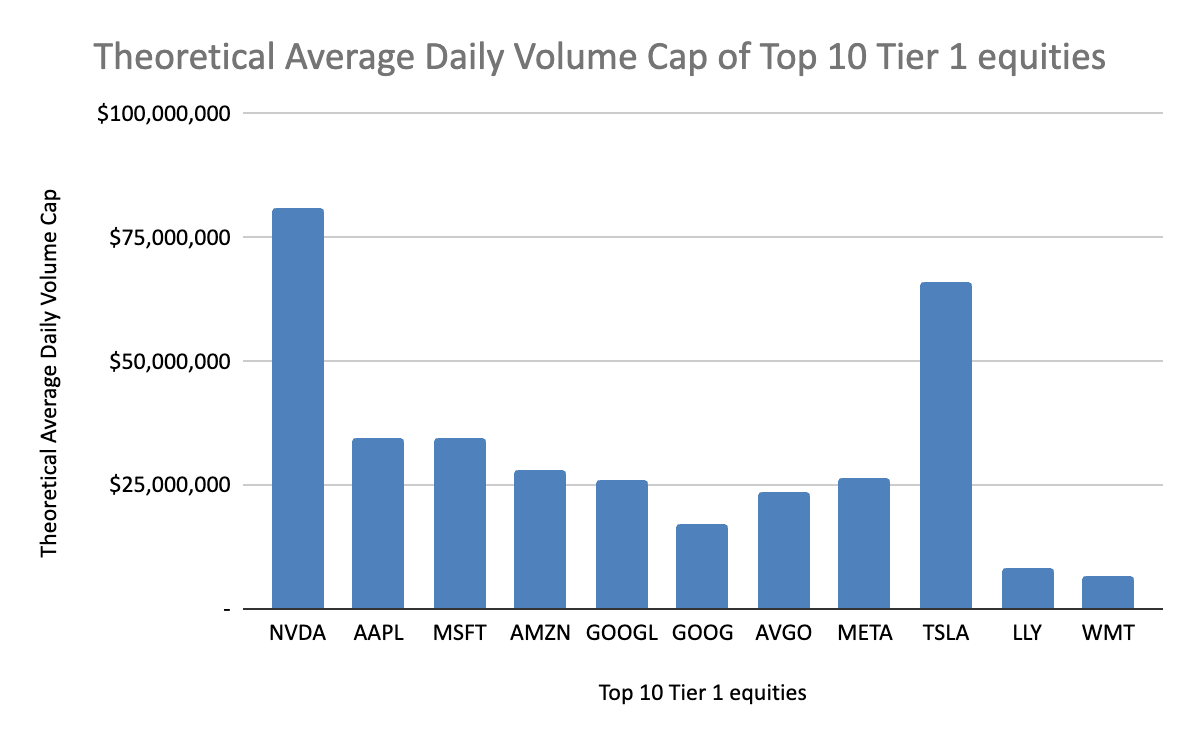
NVDA's cap comes to about $80 million a day and TSLA's about $65 million. Most of the rest sit between $15 million and $35 million, with LLY and WMT under $10 million.
To put those numbers in context, the second chart aggregates the theoretical Tier 1 cap across the top 75 Tier 1 equities and places it alongside the total average daily volume of several AMM projects. Summed across those 75 names, the Tier 1 cap is roughly $0.7 billion a day. Uniswap averaged about $2.1 billion a day over the same period, PancakeSwap about $1.5 billion, Aerodrome about $0.5 billion, and Raydium about $0.3 billion. A maxed-out Tier 1 book would more than double Aerodrome's or Raydium's volume and add about a third of Uniswap's. Tokenized-securities flow would likely supplement, not dominate, traditional crypto token volumes.
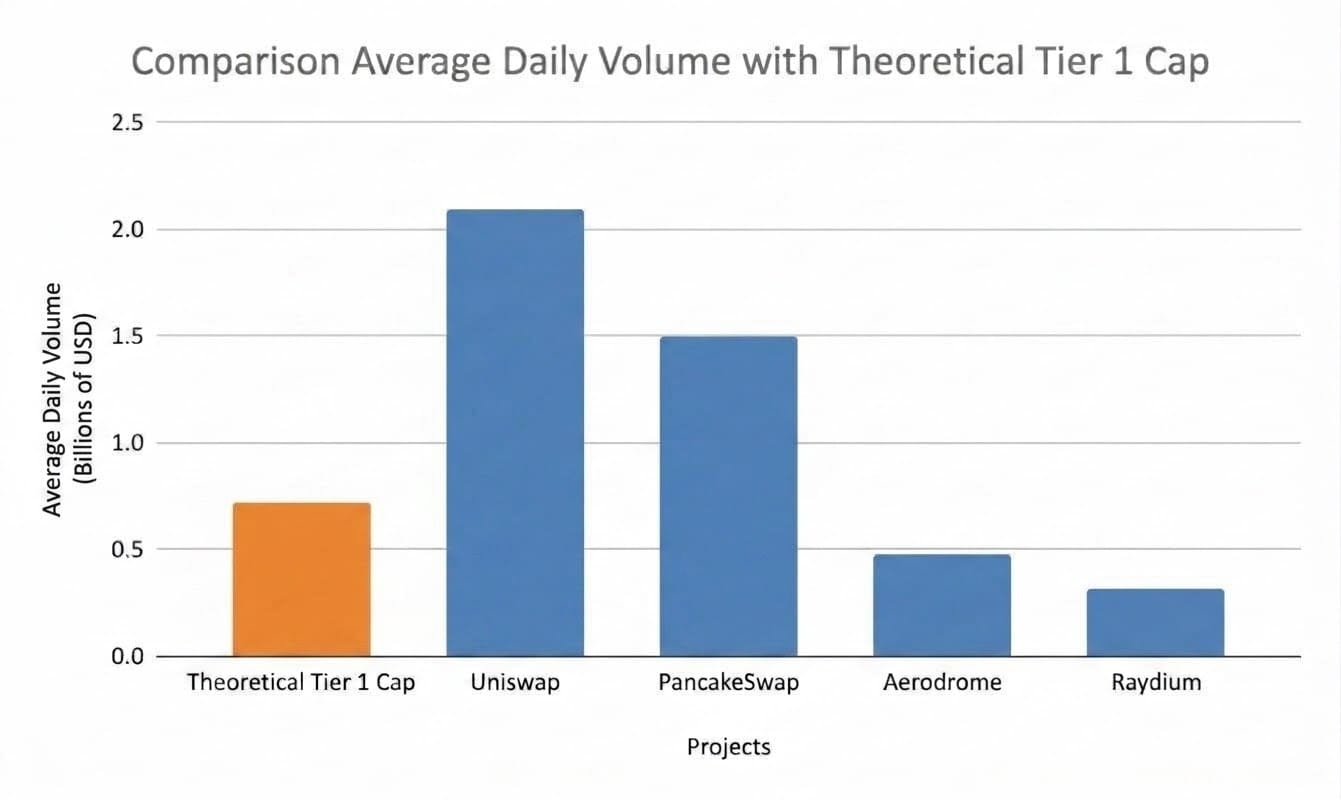
Although the $0.7 billion aggregate Tier 1 cap is impressive, there is one caveat: the caps apply per NMS Stock. A single popular security can hit its cap even if other equities on the same TSV see very little volume. The aggregate figure above overstates the effective ceiling if investor interest concentrates in a handful of names.
The Volume Cap Has an Oracle Problem
The order defines the volume cap against data that cannot be known in real time:
The percentage of the average daily share volume during the prior month for a given security shall be calculated using the average daily share volume of a given Tokenized NMS Stock traded on the TSV as the numerator, and the average daily share volume of the NMS Stock (as reported by an effective transaction reporting plan) as the denominator.
In March, the cap for a given symbol is a ratio of February tokenized volume on the TSV to February volume reported via the NMS plan. It is straightforward to code an AMM contract to halt trades once a fixed monthly volume is reached. But here is the complication: under the order, the exact threshold depends on data that only crystallizes after the reference month closes, precluding a hard cap from being coded.
The fixes fall into a few shapes: a rolling on-chain estimate with a haircut, a trusted oracle publishing prior-month ADV at the start of each month, or a permissioned keeper with authority to halt trading if a threshold is breached. Each has to navigate the same tradeoff: maximize allowed volume under the cap without going over. The first TSV to launch will almost certainly operate with a self-imposed buffer well below the stated cap.
The Bottom Line
The Innovation Exemption caps are permissive at current volumes. A TSV that hits the 0.25% Tier 1 ceiling across the top 75 symbols is running a book of roughly $700 million a day: larger than Aerodrome or Raydium today, and about a third of Uniswap. That is meaningful. It is also not a merger of DeFi and TradFi liquidity, and it will not be under this exemption. The nearer-term constraint is not the ceiling: it is the oracle problem. Until the industry converges on a way to define the cap against data an AMM can actually see, the first TSVs will be trading well inside the line the SEC drew.
About the Digital Securities Initiative
The Digital Securities Initiative is an open collaboration with no incorporated entity or member dues required to participate. Contributing organizations sponsor their own team members to spend time on the initiative when it is in their interest.
It was started by Confusion Capital, which is involved in the Reserve project. Reserve has a vision that depends on securities being available within DeFi, but is not itself involved in security tokenization and has no financial interest in any security tokenization company.
Learn more at digitalsecuritiesinitiative.xyz.

![[███░░░░]: Crypto mom lays the path for DeFi](/_next/image?url=https%3A%2F%2Fstorage.ghost.io%2Fc%2Fdf%2F2c%2Fdf2c7059-8617-4d25-9617-996aea279325%2Fcontent%2Fimages%2F2026%2F09%2FProgress-Bar-5.jpg&w=3840&q=75)