Nevin Freeman on Global Access Protocol: Building the Future of Compliant DeFi
An in-depth conversation with Reserve Protocol founder Nevin Freeman on the Global Access Protocol, a revolutionary system for bringing tokenized assets into DeFi while maintaining regulatory compliance and user privacy.
 Johnny ReinschOctober 21, 20265 min read
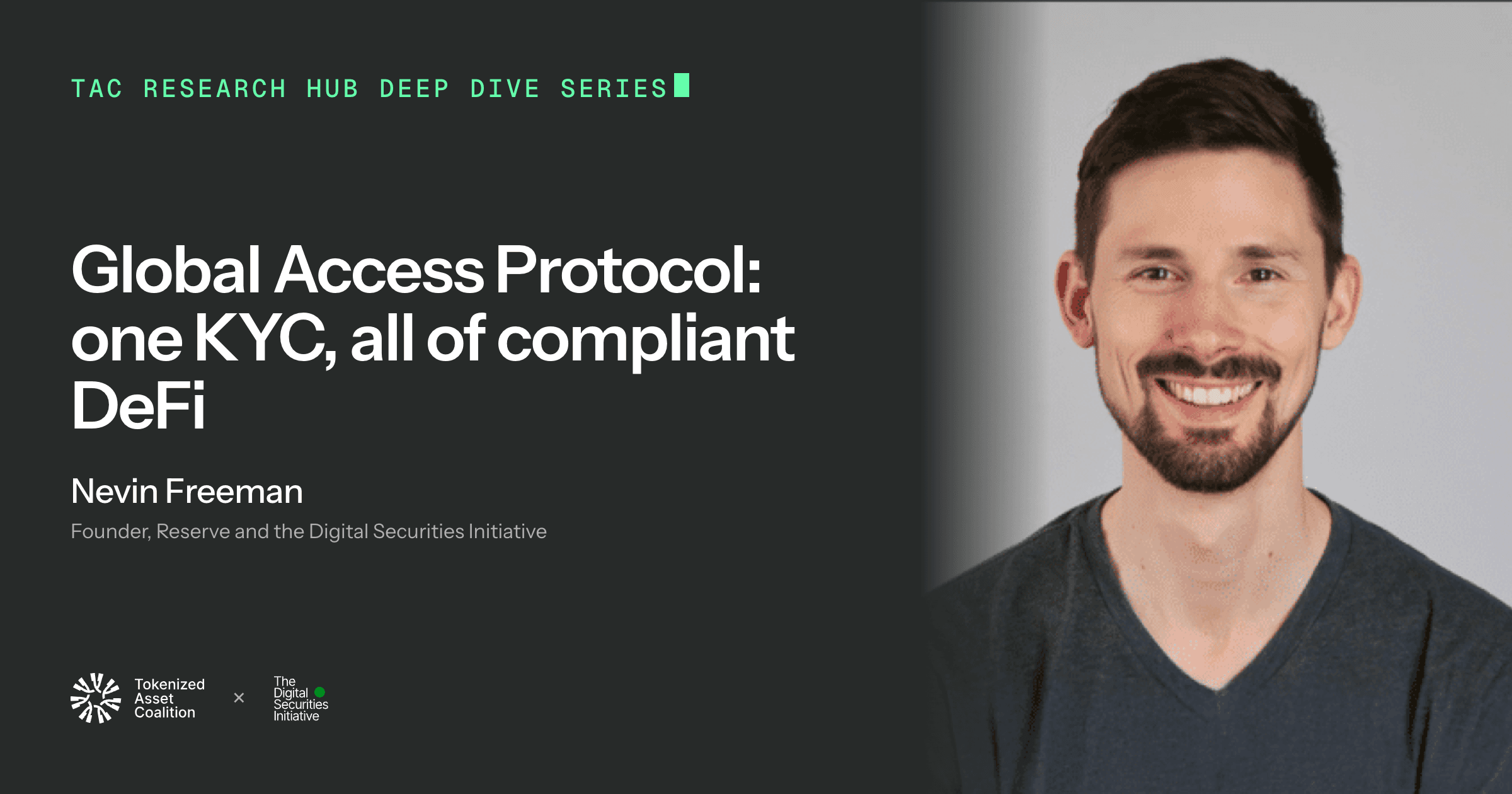
I'm thrilled to share Charlie and my conversation with Nevin Freeman, founder of Reserve Protocol and the Digital Securities Initiative, where we explored the Global Access Protocol (GAP), a groundbreaking initiative that promises to transform how tokenized assets operate in DeFi. This collaboration between the Digital Securities Initiative and the Tokenized Asset Coalition addresses one of the most pressing challenges in our industry: how to maintain the open, permissionless nature of DeFi while ensuring full regulatory compliance.
Nevin's Vision: From Reserve to Global Access
Nevin's journey began with Reserve Protocol's ambitious goal of creating an inflation-proof world reserve currency backed by real-world assets. The team built what they describe as the "decentralized version of Vanguard," allowing anyone to bundle tokens into decentralized token folios (DTFs). This work naturally led them to confront the regulatory challenges surrounding tokenized assets.
After extensive research and conversations with policy experts across the industry, including Commissioner Peirce at the SEC, Nevin reached a sobering conclusion: nobody was seriously working on the regulatory framework needed for compliant DeFi with tokenized assets. This realization sparked the creation of the Digital Securities Initiative and, eventually, our partnership on the Global Access Protocol.
The Current State: A Broken System
Today's tokenization landscape is fundamentally broken. Most projects operate with whitelist systems where users must go through KYC with every single issuer. Imagine wanting exposure to 25 different tokenized assets in an index fund. Under current systems, you'd need to be whitelisted by all 25 issuers. This creates an impossible user experience and destroys the composability that makes DeFi powerful.
Smart contracts can't interact with these tokens unless they're specifically whitelisted, which means DeFi protocols must individually convince every tokenizer to review their code and approve their contracts. When protocols upgrade their smart contracts, they need to repeat this process. It's the antithesis of permissionless innovation.
The current state offers roughly 50 basis points of cost savings to the existing intermediated financial system through slight technical upgrades. That's not transformation. That's barely innovation. If that's all we achieve after years of building, I might jump out the window. We need something bigger.
The Global Access Protocol Solution
Global Access Protocol solves this through an elegant three-axis design that balances privacy, compliance, and permissionless composability. Here's how it works from different perspectives:
For Users: You complete KYC once with an identity keeper of your choice. This entity issues you a verifiable credential, a digital identity document that you control. You can then access any tokenized asset in the entire system without additional KYC requirements. You maintain as much privacy as legally possible while ensuring compliance.
For DeFi Developers: Protocols integrate a transaction filter that checks users' credentials via zero-knowledge proofs before allowing transactions. Developers can self-certify their applications with a trust anchor rather than seeking individual approval from every tokenizer. This creates effectively permissionless innovation while maintaining compliance guardrails.
For Issuers: Asset issuers can tokenize their securities and immediately access the entire DeFi ecosystem without managing individual whitelists or relationships with every protocol. Their tokens flow freely throughout compliant DeFi infrastructure.
The Architecture: Trust Anchors and Ecosystem Actors
The system operates through several key actors. Trust anchors serve as commercial entities that establish the rules and relationships within the ecosystem. Critically, there's no single trust anchor. Multiple competing trust anchors prevent centralization and regulatory capture.
Identity keepers handle KYC and issue verifiable credentials. Users choose their preferred identity keeper based on their privacy preferences and trust levels. Transaction monitors watch for suspicious activity like market manipulation or money laundering, using encrypted pseudonyms to protect privacy while enabling compliance. Contract certifiers (DeFi developers) can self-certify their applications for inclusion in the ecosystem.
When something goes wrong, the system provides targeted responses. If I start sandwich attacking traders in a specific pool, the transaction monitor flags my pseudonym for that contract only. I lose access to that pool but can continue using other parts of the ecosystem. This granular approach prevents overly broad punishment while maintaining effective compliance.
Privacy and Compliance: Threading the Needle
The privacy model deserves special attention. Users create unique pseudonyms for each contract they interact with, derived from their identity and the contract address. Transaction monitors can see these pseudonyms and detect patterns across multiple addresses owned by the same person, solving the Sybil attack problem. However, they can't see your real identity unless they obtain it separately from your identity keeper.
This creates important privacy protections. No single entity accumulates both transaction histories and real identities. If regulators need information for legitimate investigations, they must follow due process: transaction monitors can file suspicious activity reports using pseudonyms, regulators can request specific information from identity keepers, and identity keepers can refuse requests that lack legal justification.
The system protects against financial oppression. An authoritarian government can't simply peek into all financial transactions of its citizens. They must follow the same friction gates and legal processes as democratic governments, preventing mass surveillance and property confiscation.
Regulatory Engagement and Future Outlook
Our engagement with the SEC has been remarkably positive. The establishment of the crypto task force under the new administration completely changed the conversation. SEC staff demonstrate genuine curiosity, asking intensely smart (and challenging) questions about the system. They're principled in protecting capital markets and investor interests, refusing to create regulatory moats for any specific blockchain or company.
We're currently seeking exemptive relief that would allow us to operate a V1 of the system. This involves working through details around transfer agent requirements, Delaware corporate law, and state regulations. Once we obtain permission and demonstrate the system works, we expect rapid adoption as market participants see the benefits firsthand.
The long-term vision includes potential formal rulemaking by the SEC and even congressional legislation to codify these principles. This mirrors the evolution from paper certificates to electronic settlement in the 1960s, when the Banking and Securities Industry Committee redesigned the entire financial system architecture to solve the "paperwork crisis."
A Historical Parallel: Learning from the Past
The paperwork crisis of the late 1960s offers a perfect parallel to our current situation. Stock trading volume had grown so large that brokers couldn't physically transfer paper certificates fast enough. The SEC actually closed markets on Wednesdays just to catch up on paperwork. Industry leaders formed the Banking and Securities Industry Committee, spent two years designing a solution, and created the Depository Trust Company.
That redesign gave us the financial system architecture we use today. The difference is we're not facing a crisis, we're seeing an opportunity. We're not replacing the current system entirely, we're augmenting it with new capabilities that will expand the total addressable market and create new possibilities for innovation.
The Future We're Building
Imagine a world where you can swap tokenized Apple stock for oil futures from a Middle Eastern exchange in a single atomic transaction. Where you can borrow against your tokenized assets at algorithmic interest rates, just like borrowing on Aave today. Where a startup in any country can tokenize their equity and immediately access global capital markets.
This isn't just about 50 basis points of cost savings. This is about democratizing access to sophisticated financial tools traditionally reserved for high net worth individuals and institutions. It's about creating a single global liquidity pool for all assets, regardless of jurisdiction or asset class. And it's about doing all this at machine speed while maintaining compliance.
The Global Access Protocol represents our industry's best chance to achieve true financial inclusion while maintaining the regulatory compliance that institutional adoption requires. We're not asking people to choose between innovation and compliance. We're proving you can have both.
For those interested in diving deeper, you can find my info on our site.