Verify Once, Trade Anywhere: Inside the Global Access Protocol
How the Global Access Protocol puts compliance inside the smart contract, so tokenized securities can live on open blockchains without rebuilding the middlemen.
 Johnny ReinschOctober 19, 20265 min read
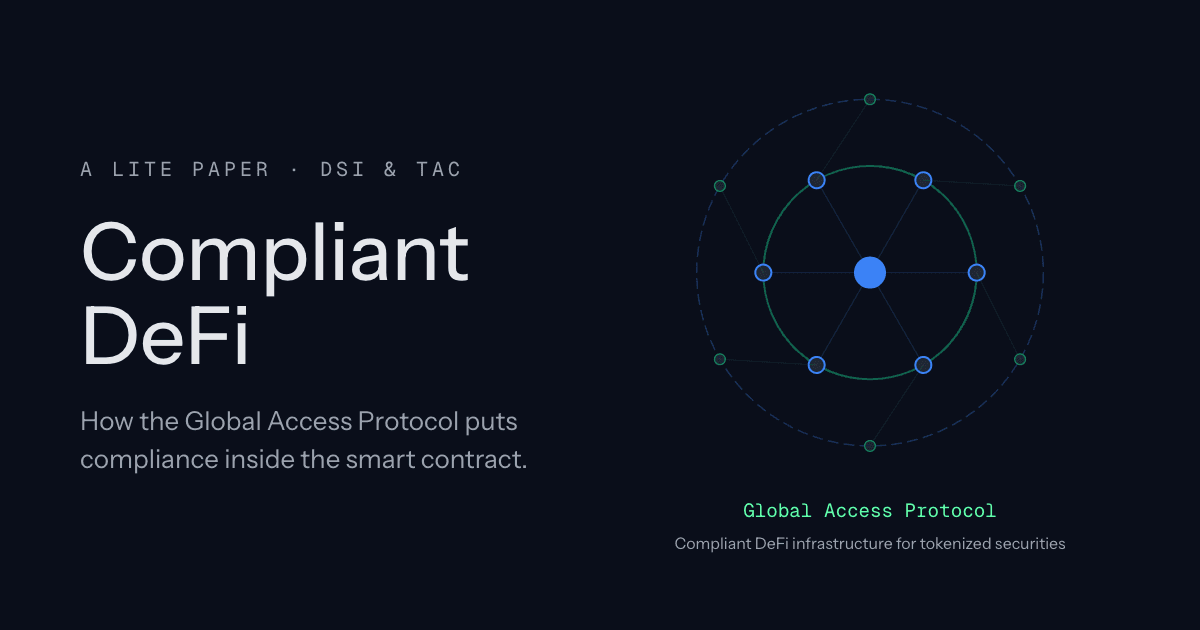
For the past year, the Tokenized Asset Coalition and the Digital Securities Initiative have worked on one question: how do you bring regulated securities onto permissionless blockchains without rebuilding the intermediaries that tokenization was supposed to replace?
Our answer is the Global Access Protocol (GAP), an open-source compliance layer, and the Model Regulatory Framework that governs it. We developed it through dozens of meetings with the SEC's Crypto Task Force and division staff, the CFTC, the Department of the Treasury, legal counsel and policy leaders across the industry.
The full lite paper is live on our site. Here is the short version.
Two financial systems
The first is the intermediated system most investors know: brokers, advisors, custodians and clearing houses. It works, but it is slow, expensive and built around trusted middlemen.
The second is disintermediated. An investor can self-custody assets, trade around the clock, borrow against positions instantly and combine financial products in ways that would take months to negotiate through traditional channels.
Both should exist, side by side. Tokenized assets onchain have grown from about $25 billion to more than $39 billion over the past year, against a global securities market above $250 trillion. The lite paper focuses on the second system, because that is where the most innovation is possible and where a new regulatory approach is most needed.
The impasse
Financial regulation assumes intermediaries who identify customers, monitor transactions and enforce rules. Permissionless blockchains don't need those gatekeepers. Tokenized securities need compliance, compliance has historically required intermediaries, and intermediaries bring back the friction tokenization was meant to remove.
Take an investor who holds a tokenized Treasury on one platform and wants to use it as collateral to buy a tokenized equity on another. Today that is nearly impossible. Each platform keeps its own whitelist, so the investor repeats KYC, waits for manual approval and hopes the two platforms have built an integration.
Five problems follow from this:
- Whitelist fragmentation. Every issuer keeps its own list, and liquidity splinters into silos.
- Deglobalization. Bespoke rules in each jurisdiction wall capital off along political borders.
- Surveillance. Without protections, every transaction and identity is visible to everyone.
- Slow doxing. Poorly designed systems leak clues until pseudonymity erodes.
- Regulatory moats. A few providers use compliance requirements to shut out competition.
The fix: Regulated Zones
Rather than choosing between compliance and decentralization, the framework puts compliance into the smart contracts themselves.
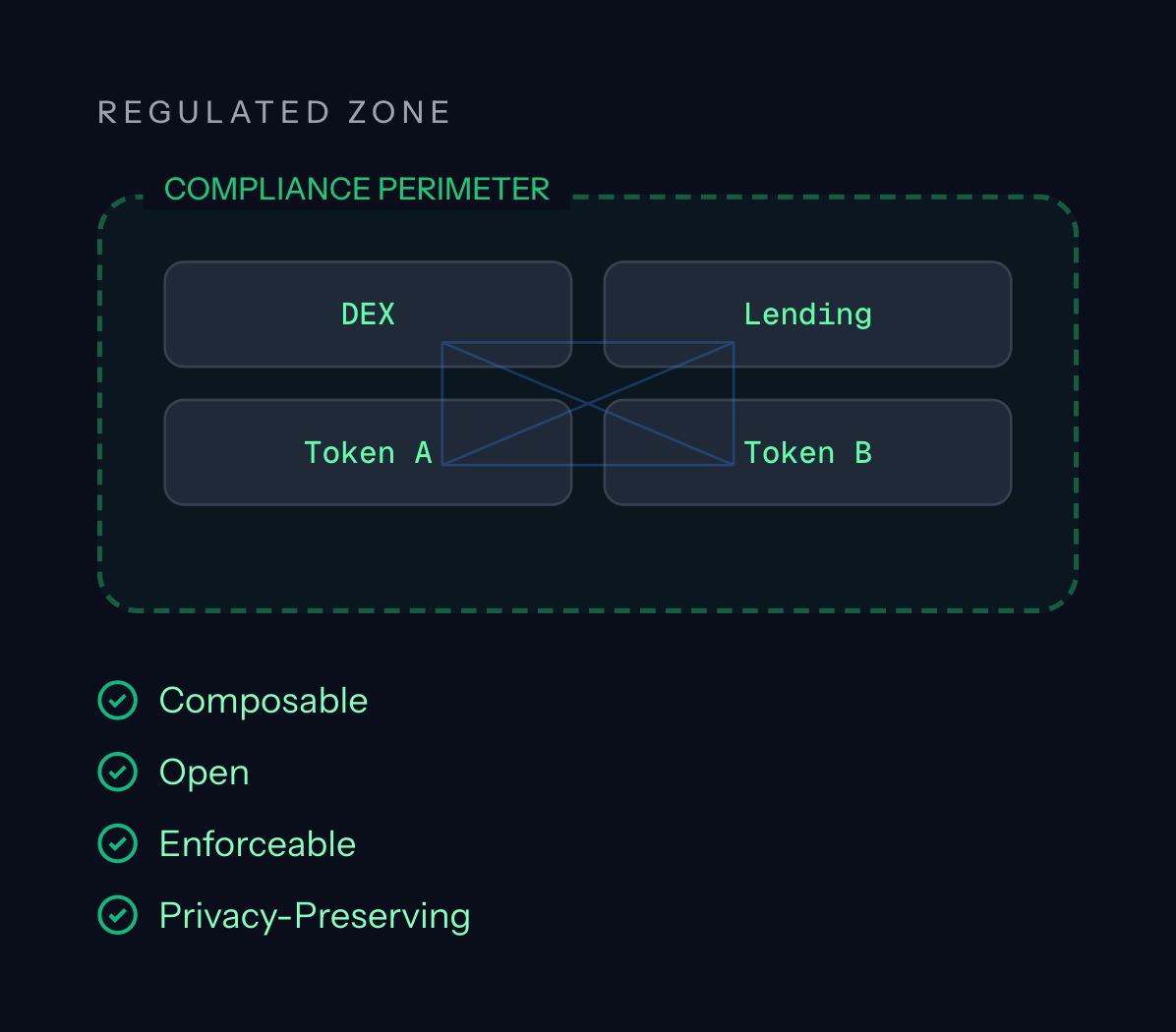
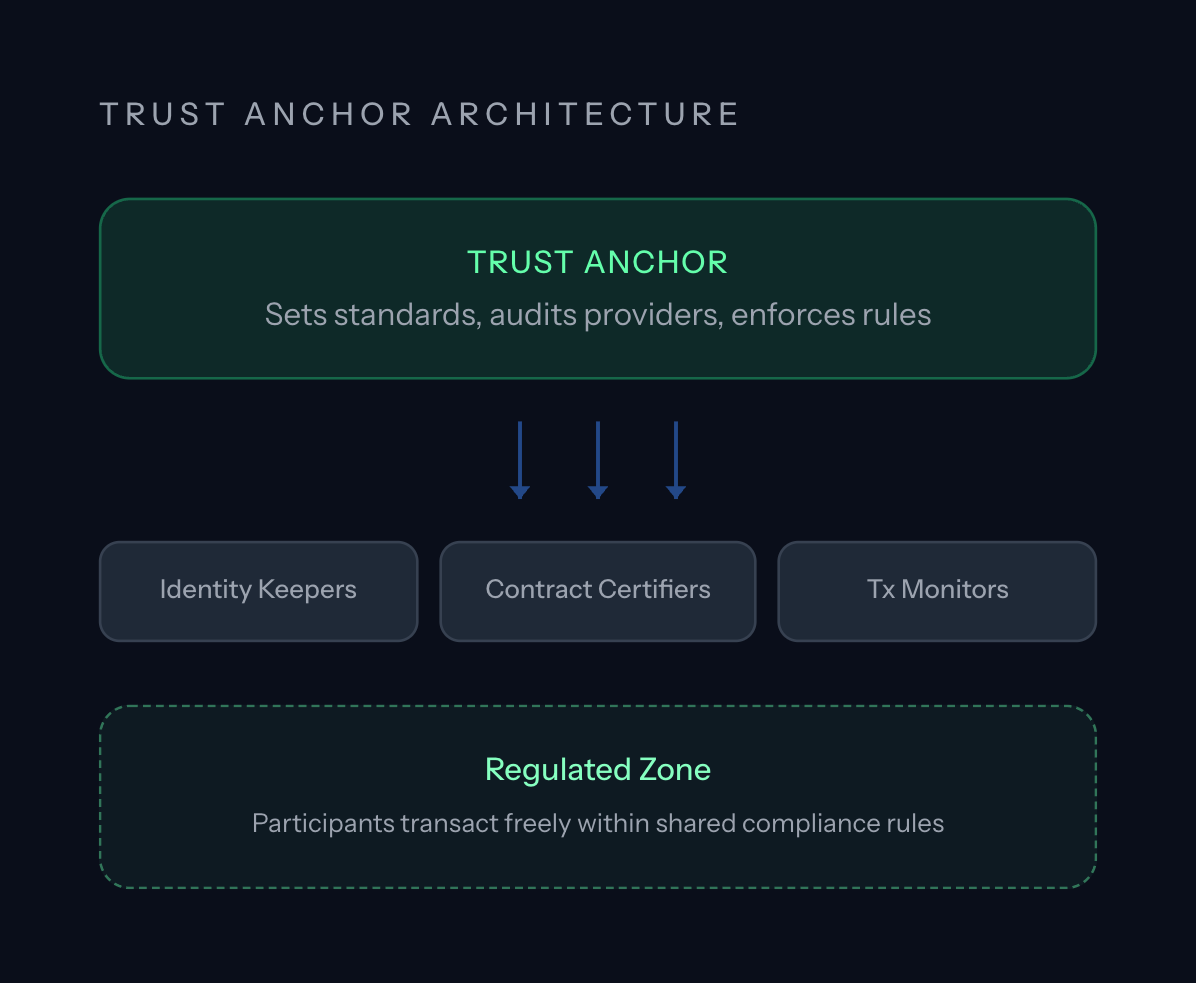
The core idea is the Regulated Zone: a compliance perimeter that sits on top of existing networks like Ethereum or Solana. It is not a separate chain. It is a set of smart contracts that have agreed to enforce the same rules. Because they share one protocol, they work together freely. A security issued by one company can trade on a DEX built by another and serve as collateral in a lending protocol built by a third, all inside the same perimeter.
Who does what
Four roles keep a Regulated Zone running:
- Trust Anchors set the rules. Each one administers a zone, publishes standards, audits service providers and maintains the Terms of Service. There can be many, for different asset classes and jurisdictions, so no single entity becomes a chokepoint.
- Identity Keepers handle KYC and sanctions screening, then issue privacy-preserving credentials tied to the user's onchain identity. Personal information never touches the chain. Because the data standards are shared, a user who onboards once can reach assets across many zones.
- Contract Certifiers review smart contracts against the zone's standards and issue credentials that classify them, such as a Reg D offering, a DEX or a lending protocol.
- Transaction Monitors watch onchain activity for sandwich attacks, structuring, sanctions exposure and manipulation. They work only with pseudonymous data and publish graded risk flags rather than a simple blacklist.
Enforced at the moment of the trade
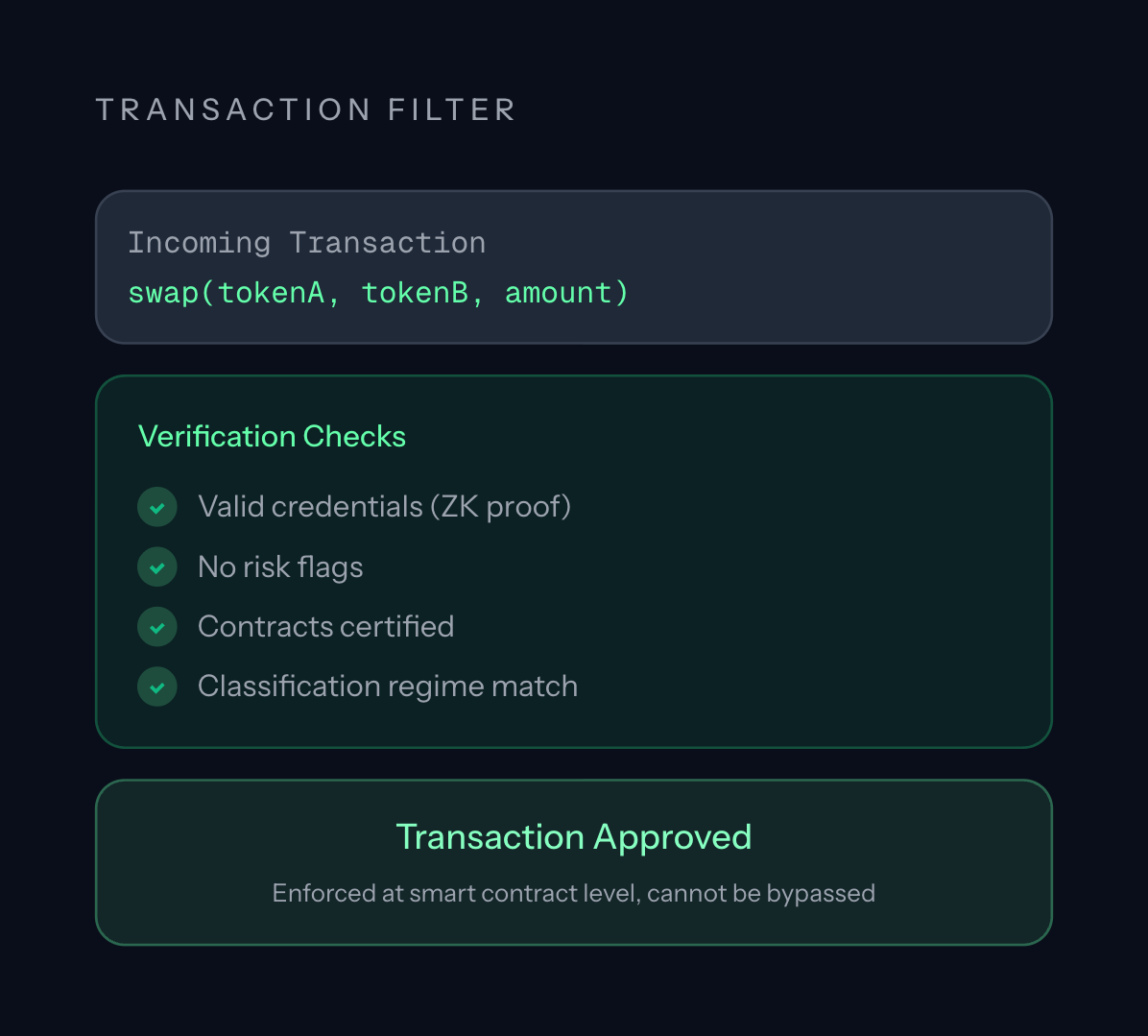
Everything comes together in the Transaction Filter, a module inside each smart contract. When a user starts a transaction, the filter confirms that every party and contract holds the required credentials, that no risk flags block it, and that any contract it touches is certified. If anything is missing, expired or revoked, the transaction is rejected.
Users prove they hold the right credentials with zero-knowledge proofs. The contract learns that a user has passed KYC and is not sanctioned without learning who the user is.
Privacy by design
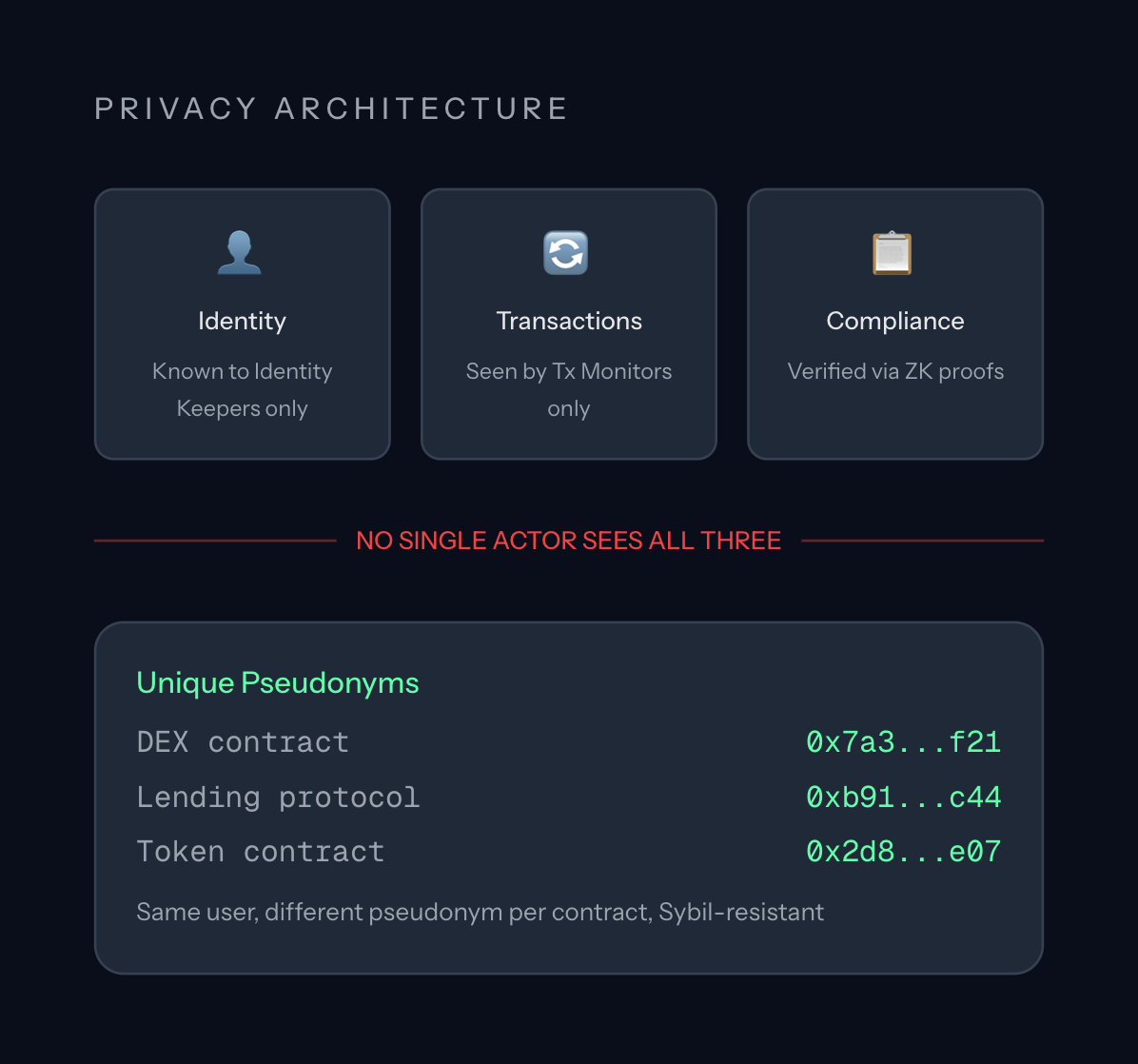
The system separates three kinds of sensitive information: who a user is, what they trade, and the compliance status of the contracts they use. No single actor sees all three. Identity Keepers know who users are but not what they trade. Transaction Monitors see trading patterns but not who is behind them. The protocol prohibits any entity from playing both roles.
Users also transact under a different pseudonym for every contract, so activity in one place can't be linked to activity in another. The pseudonyms are Sybil-resistant, so one person can't pose as many.
What a trade looks like
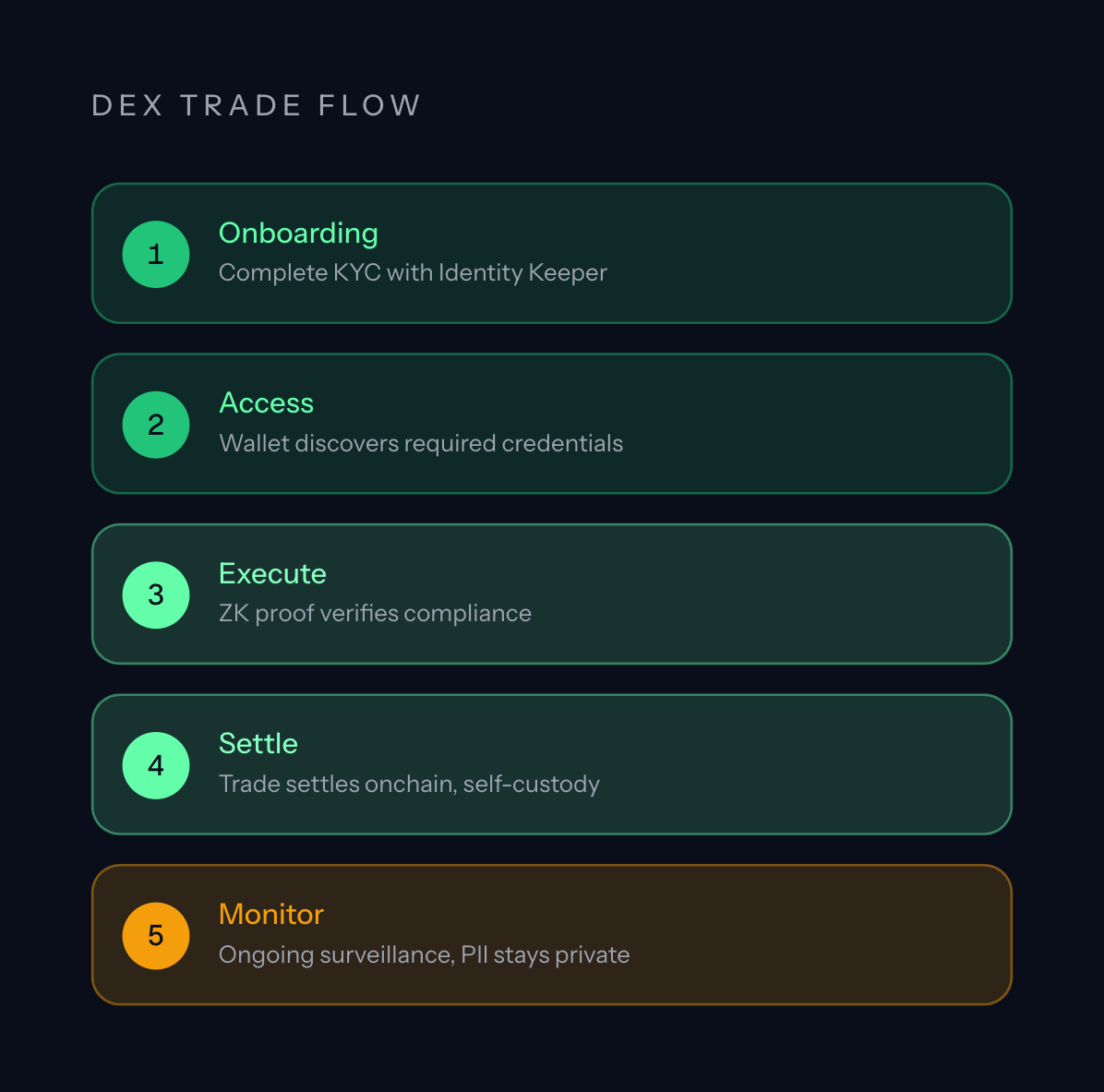
- Onboard. The investor completes KYC once with an Identity Keeper and receives credentials.
- Access. Their wallet sees that the DEX is in a Regulated Zone and generates a zero-knowledge proof.
- Execute. The DEX's Transaction Filter verifies the proof and checks that the securities and contracts are certified.
- Settle. The trade settles onchain, and the investor holds the security in self-custody.
- Monitor. Transaction Monitors observe the trade. If a regulator needs to know who made it, a referral process leads to the Identity Keeper. Personal information never leaves the Identity Keeper otherwise.
What regulators keep
The framework maps directly to the risks the SEC and other agencies have raised about digital asset markets:
- Offering restrictions. Investor eligibility, Reg D limits, Reg S geography and holding periods are all programmable in the Transaction Filter.
- MEV and sandwich attacks. Monitors detect them, and certified contracts implement execution fairness controls.
- Market manipulation. Monitors flag flash-loan attacks, oracle manipulation and wash trading. Bad actors can be ejected from the zone.
- AML and sanctions. Credentials are revoked automatically when someone is added to the OFAC list.
Why it matters
The Model Regulatory Framework is a blueprint for public infrastructure that enforces sanctions compliance, KYC, market integrity and investor protection, while keeping what makes permissionless blockchains valuable: composability, open access, competitive markets and privacy.
The goal is a financial system where you verify your identity once and gain access to regulated markets worldwide. Developers build applications that work across jurisdictions. Investors trade without exposing their positions or personal information. And regulators keep the tools they need.
The lite paper goes deeper on each piece, including how pseudonyms, risk flags and referrals work under the hood.
The Global Access Protocol is being developed by the Digital Securities Initiative and the Tokenized Asset Coalition.