The Data Standard Tokenized Assets Need Before They Scale
 Niklas KunkelNovember 5, 20264 min read
The world's assets are moving onchain. The tokenized asset market grew 208% in the past year alone, reaching $38 billion in August. The issuers behind that growth are household names: BlackRock, Janus Henderson, Apollo, BNY Mellon, Fidelity, WisdomTree. Citi, ARK, and BCG place 2030 forecasts between $8 trillion and $23 trillion. The remaining disagreement is over how big the market gets, not whether it grows.
What that growth depends on, and what the industry is still catching up on, is transparency.
Tokenized assets inherit their truth from the offchain world
A tokenized asset differs from a crypto-native asset in one key way: its non-nativeness. Assets like Bitcoin and ETH are fully described by the chains they live on; there is nothing else to know about them. A tokenized treasury fund or a tokenized CLO, on the other hand, is a representation of a complex, structured product that lives offchain. The information that determines its value and backing (its underlying holdings, their valuation, and custody arrangements) also exists offchain.
Making all that information available onchain matters for two reasons: safety and utility. It makes the asset safer to hold because it tells you that the underlying assets exist and match exactly what the token claims to represent. It makes the asset maximally useful because every onchain system that lends against it, sizes exposure to it, or settles redemptions in it can only act on what it can see. Without that information being precise, real-time, and verifiable, a protocol is working from a figure it cannot check.
The goal, in my opinion, is for anyone creating a tokenized product to have the tools to provide its full composition in real time, so that anyone using it knows exactly what they are interacting with. The test is straightforward: at any moment of any day, anyone should be able to verify with full confidence that the asset they are using onchain is completely backed by the offchain asset it claims to be.
So we decided to measure this.
The five dimensions of transparency
At Chronicle we sit between the records that issuers keep and the onchain protocols that need to read them, so we see all the methods used to answer that question for increasingly complex types of assets. We have a commercial interest in this problem; we built the framework below from the problems we see, and others may weight the dimensions differently. Transparency is a spectrum, and measuring it requires a nuanced method. We established five dimensions of tokenized asset transparency:
- Independence: is the data reported by a third party, or by the issuer?
- Granularity: are asset-level holdings available, or just a single NAV?
- Frequency: how often is the asset information refreshed?
- Verifiability: can anyone confirm the data hasn't been altered, or does a single party need to be trusted?
- Onchain Availability: can a smart contract reference the complete asset information?
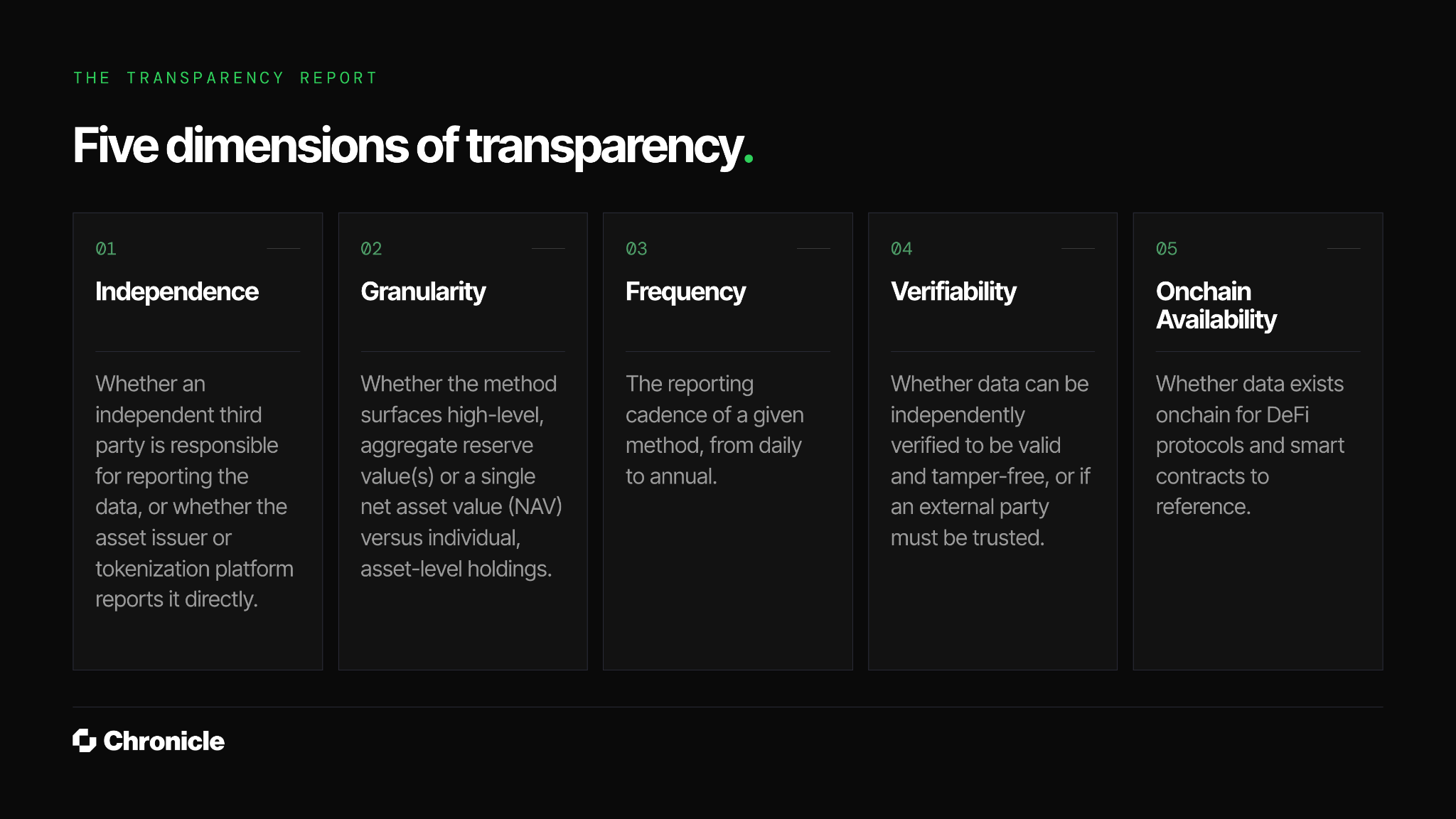
A tokenized asset that clears all five dimensions meets the standard of transparency. What it says matches what sits offchain, and that can be verified independently, in detail, at any time, provably, and in a form onchain systems can refer to.
The findings: over 70% of the market isn't transparent
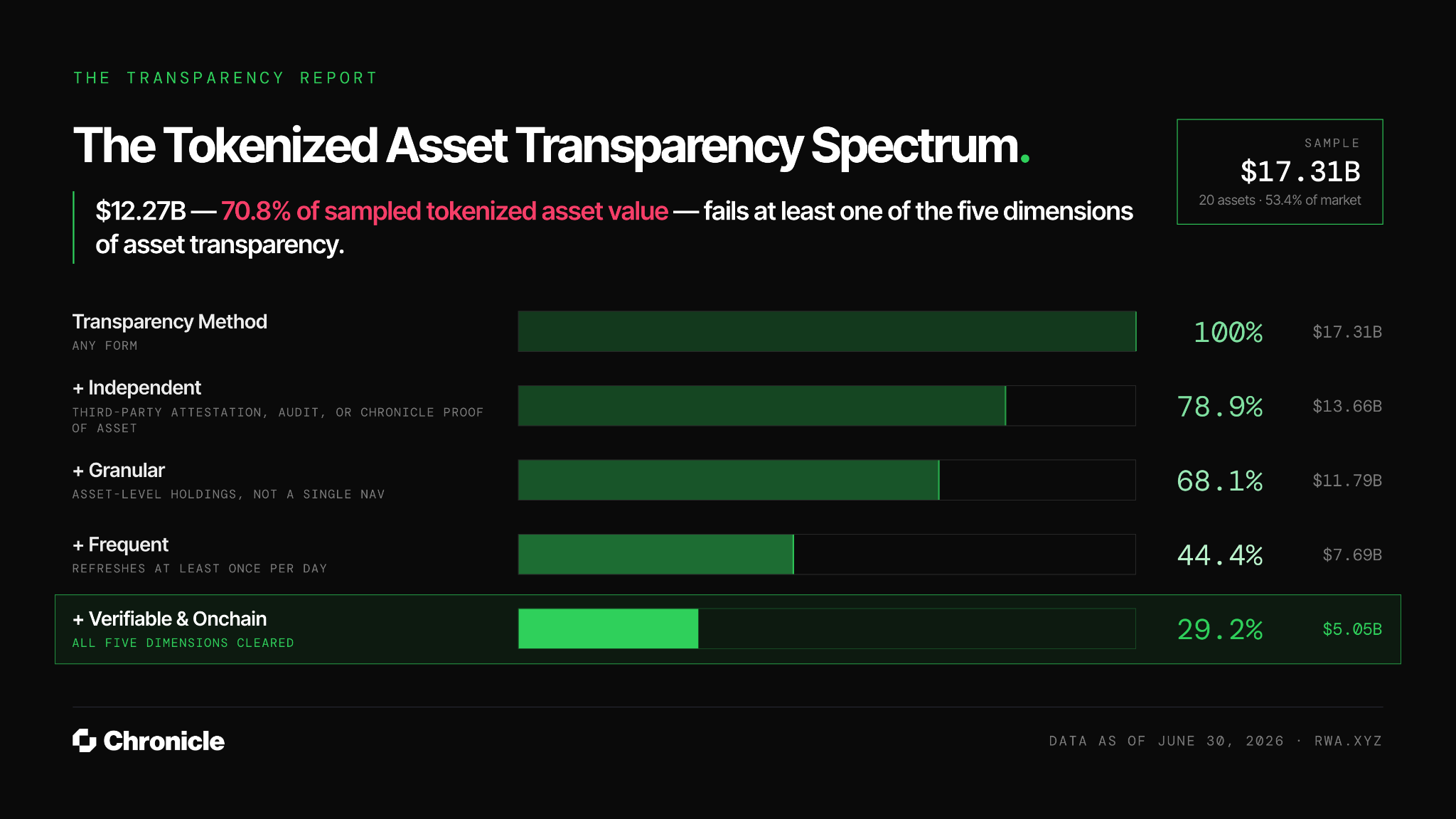
The complete findings are available in the full report, including the full list of assets sampled and the pass/fail criteria for each dimension. The short version: we applied the five dimensions to 20 of the largest tokenized assets (9 tokenized treasuries and 11 onchain credit products) together worth $17.3B, or 53% of the entire tokenized asset market excluding stablecoins. Then we ran those assets through each dimension in order and measured how much of that value clears all five.
The answer is 29.2%. More than 70% of the asset value we sampled (about $12.3B) falls short on at least one dimension. For the bulk of tokenized assets, the wrapper isn't transparent, and anyone building on top of those tokens is relying on data that is incomplete in at least one way.
Two things in particular jumped out while reviewing the data.
First, the steepest dropoff occurred at the frequency dimension. Nearly 70% of sampled value passes both independence and granularity. When we applied frequency, less than half of the sampled value reported on a daily schedule. This is the next hurdle for the ecosystem: evolving from the less frequent reporting cadence of traditional finance toward daily or real-time reporting.
Second is the emergence of a standard from the established names of traditional finance. The sampled assets that do pass all five dimensions come from the most regulated issuers: BlackRock, Janus Henderson, Apollo, BNY Mellon. These firms, with decades of experience in data management and reporting, have elected to make their token wrappers entirely transparent. We expect this behavior to become an implicit standard for tokenized assets.
One caveat worth stating: how much transparency an asset needs scales with how it is used. A tokenized treasury held passively may be fine on quarterly attestations. The same asset used as collateral in an onchain lending market is not.
Productive assets require transparent data
From where we sit, data infrastructure for tokenized assets is whatever clears all five dimensions, no matter who provides it. As the market grows, that need gets harder to ignore. If the tokenized asset market reaches a conservative $4T by 2030, today's transparency standards would mean roughly $2.83T in tokenized assets existing onchain without verifiable backing.
Today's state of tokenized asset transparency doesn't need to be an omen for the future. Clearing all five dimensions doesn't require reissuing anything. The holdings data already exists with custodians and administrators; the work ahead is getting it from there to onchain systems in the best form possible. Watch the frequency dimension specifically: when daily or real-time asset-level reporting becomes table stakes rather than a feature of the top issuers, the market will have crossed the line from "tokenized" to "productive."
Nik Kunkel is the founder of Chronicle. Chronicle is the data infrastructure layer for onchain capital markets. Its oracle network makes financial data verifiable and usable onchain, enabling institutions and onchain operators to value tokenized assets, assess risk, and allocate capital.